
The Sedona area is full of rocks of varied kind and colors, as is evident on any given hike. But it is also full of certain composite organisms that are often on those rocks and yet may be completely overlooked. Have you noticed crust-like mats on sandstone or basalt surfaces, perhaps a neon or mint-colored green, or orange or yellow? One of the volunteer activities, taken on by the non-profit organization Friends of the Forest, through its Wildlife/Fish/Range/Plants Committee, is inventorying these unique biotic beings known as lichens. The project, which requires specialized training to learn proper collection techniques, helps the U.S. Forest Service understand and track lichen species within the Red Rock Ranger District.
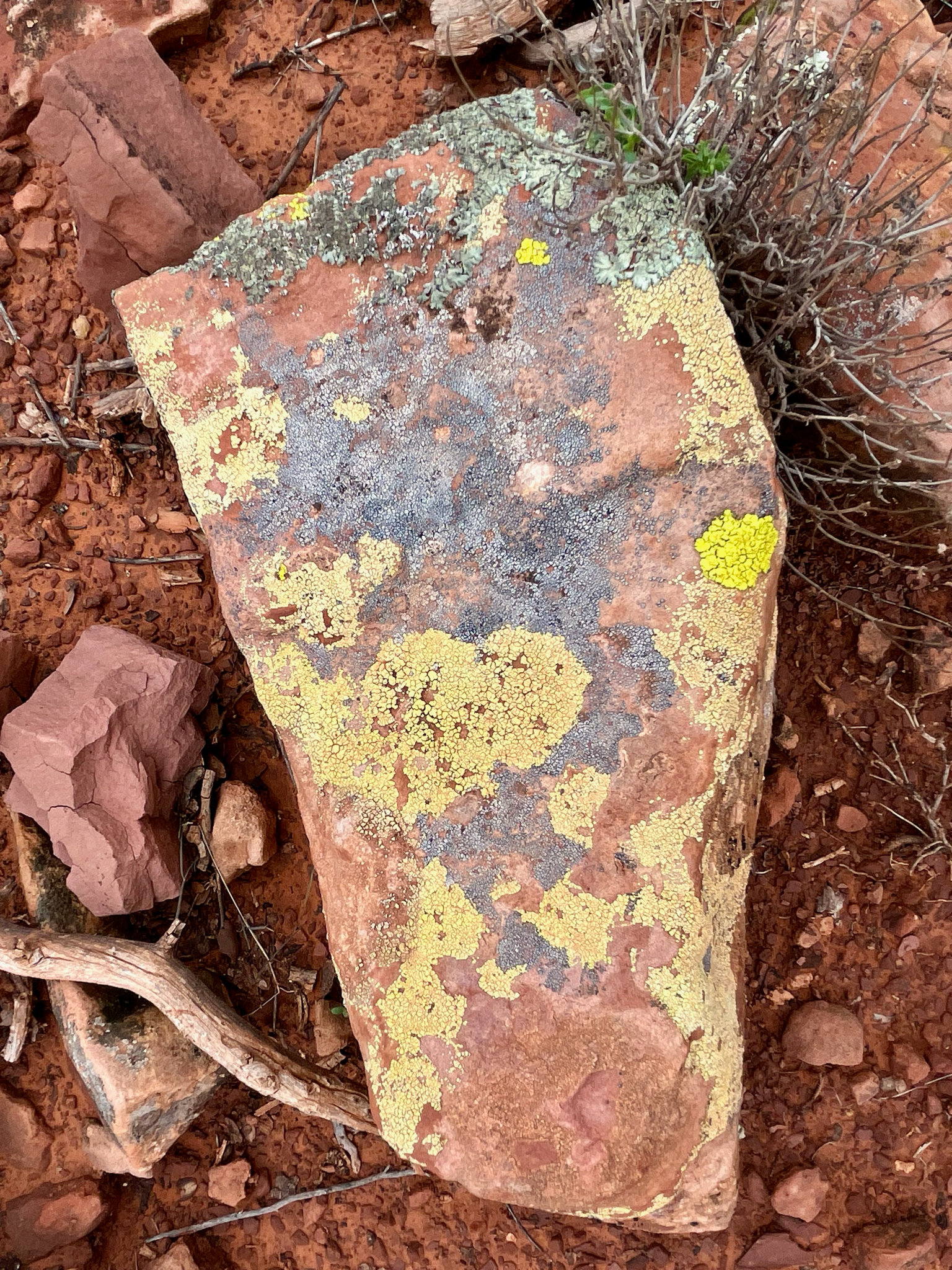
Several species of lichen on a sandstone rock along the Lower Chimney Rock Trail.
Lichens are fascinating symbiotic systems composed of fungi and algae (green algae or cyanobacteria). One way to think about them is as “fungi that discovered agriculture.” The fungi can’t make their own food and benefit from the sugars created through the algae’s photosynthesis, and the fungi provide a structure that helps protect the algae. Lichens are found on various substrates, including rocks, trees and shrubs, and soil.
Another interesting and important facet of lichens is they don’t have roots and so must acquire all of their water and nutrients directly from the air. This makes them excellent indicators of air quality. Some lichen field guides even have a category for each species, listing which air pollutant it is sensitive to, such as ozone or sulfur dioxide. On rocks, lichens slowly but surely (some species grow only one millimeter per year!) contribute to the breakdown and formation of an initial layer of soil, which then can be colonized by plants.
Critical to the inventory project is volunteer Garry Neil, who has been leading the effort for eight years. He is directly in charge of processing the collected specimens, which includes identifying, preparing, and sending them to the lichen herbarium at Arizona State University, another project partner. Identifying lichens is not an easy task, sometimes requiring chemical analysis, and possibly thin-layer chromatography (a way of separating out chemical compounds within the lichen). Neil earned a Master of Science degree in lichen physiology years ago and is the exact specialist needed to do this work. To date, over 1,400 specimens have been collected. This includes many duplicates, which is good information helping to paint a picture of the distribution of each species. At least two species are new to science, and several others have been found for the first time in the Ranger District.
Three years ago, Jerry and Janet Walters started helping Neil with the collecting of specimens, and have become lichen enthusiasts. As Jerry says, “It’s great walking around out here with all of these grand vistas, but the small things make you aware of the rich diversity of the place and make your hike even more interesting.”
For Janet, volunteering on the project is increasing her enjoyment of the National Forest:
Looking for lichens has greatly expanded my experiences on the trails. “While before, in my role as a volunteer Trail Ambassador, I would hike only a few trails, over our time so far searching for lichens, Jerry and I have collected 415 specimens on 45 trails. There is an allure in exploring different areas and habitats looking for different species — it’s the thrill of the hunt.”
Lichen species carry catchy names, with some sounding like they could be from another planet. Examples of genus and common names include Usnea, Cladonia, Flavopunctelia, rock shields, and reindeer lichen. The Walters have become so focused on finding and learning about lichens wherever they are, they named a recent trip to Yellowstone National Park a “Cladonia safari.”
On your next hike, there will undoubtedly be lichens around, so in addition to admiring the view, look more closely among the rocks, trees, and soil that you walk by to find these small, tenacious, often-colorful biological partnerships right in your midst! If you would like to learn more about Friends of the Forest volunteer opportunities, visit: https://www.friendsoftheforestsedona.org.
Author: Kristine Crandall
Serving Sedona, written his week by Kristine Crandall, volunteer with Friends of the Forest, appears Wednesday in the Sedona Red Rock News.