
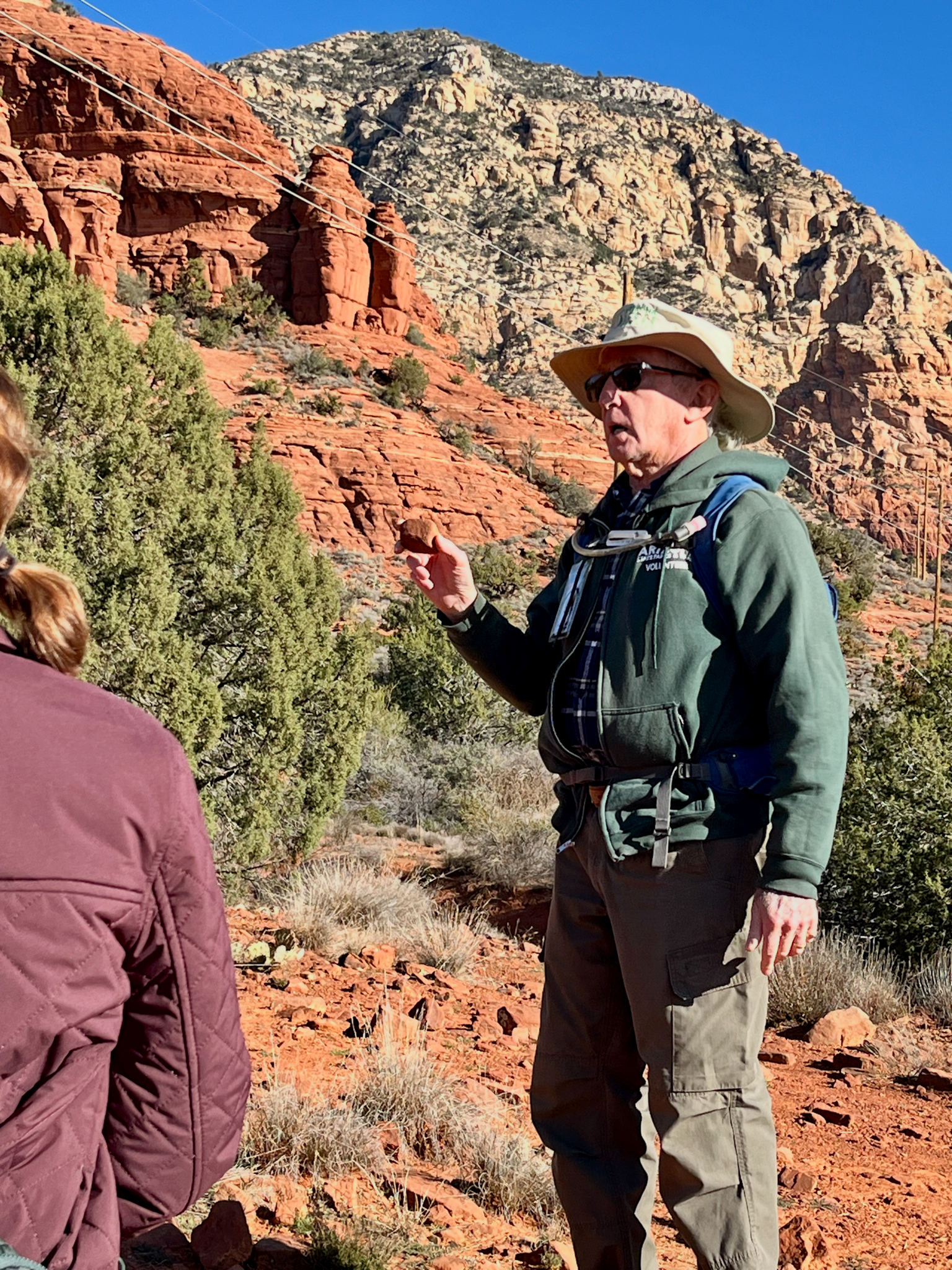
Barry Mallis holds up a piece of Hermit shale during an educational geology hike he led for Friends of the Forest volunteers on the Thunder Mountain and Chimney Rock trails.
On a recent January morning, 11 volunteers with the Friends of the Forest Trail Ambassador Committee had the pleasure of joining leader Barry Mallis for an educational geology hike. This was one of numerous educational events the organization offers for its members to support them in their various volunteer capacities. Knowledge of the area’s geology is great information the Trail Ambassadors can share with hikers they interface with on the trails. Visitors might be interested, for example, in hearing what causes the red color in the rock formations, or their amazing shapes. Also, these events are a wonderful perk for the volunteers. For this writer, knowing a bit about Sedona’s geology enriches my experience of living here.
Mallis, both a Friends of the Forest volunteer and a geology and archaeology/anthropology docent at Red Rock State Park, noted that learning about the geology right where one is hiking makes it likely one will never look at the landscape with the same eyes again. After he provided some initial overview information, there were nods of understanding as we scanned from Thunder Mountain, consisting mainly of light-gray-colored Coconino Sandstone, down to the abundant red rock around us.
A little way up the Thunder Mountain Trail, Mallis stopped and grabbed two different pieces of red rock to show us. One glittered as the sunlight hit it. This was a piece of the Bell Rock member of the Schnebly Hill Formation. The other piece looked similar but didn’t sparkle. It was a piece of shale from the Hermit Formation, upon which West Sedona sits. We were standing at a transition between these two formations. Sand, with its glittering silica crystals, is the primary component of the Bell Rock member, while non-sparkly mudstone and siltstone are dominant in the Hermit Formation.
Once the group rounded the base of Chimney Rock and could take in the vast view to the west, Mallis pointed out another geologic layer — the Fort Apache Limestone (also a member of the Schnebly Hill Formation). A distinct stripe in between sections of red rock, this darker gray corrugated-looking rock layer was laid down during a time when the entire area was covered by a sea. No doubt, one effective means of gaining a larger perspective is to ponder the many changes that have occurred to the landscape over millennia, eras, and eons. Mallis threw out a fun tidbit — the granite rock upon which Jerome’s “J” is painted is around a billion years old.
Answering the questions posed at the beginning, iron-rich sediments originating from the Ancestral Rockies were transported to the Sedona area, forming geologic layers, with the iron oxidizing over time, creating the red color. And what is the key driver of the distinct formations Sedona is famous for? It all comes down to water, and how it erodes the different sedimentary rocks. For the group of Trail Ambassadors, it was an illuminating outdoor classroom session.
Another example of a recent Friends of the Forest educational activity was a presentation on prescribed burns by staff of the U.S. Forest Service’s Red Rock Ranger District. It was quite informative, including discussion of the three main reasons why these burns are undertaken: community protection, habitat restoration, and to provide options for managing wildfires when they come.
Additional educational offerings for Friends of the Forest volunteers have included wildflower walks, bird-watching hikes, CPR and first-aid training, and nighttime photography.
To learn more about the many ways to get involved with Friends of the Forest and have access to its educational opportunities, please visit: https://www.friendsoftheforestsedona.org.
 Serving Sedona, written this week by Kristine Crandall, volunteer with Friends of the Forest, appears Wednesday in the Sedona Red Rock News.