
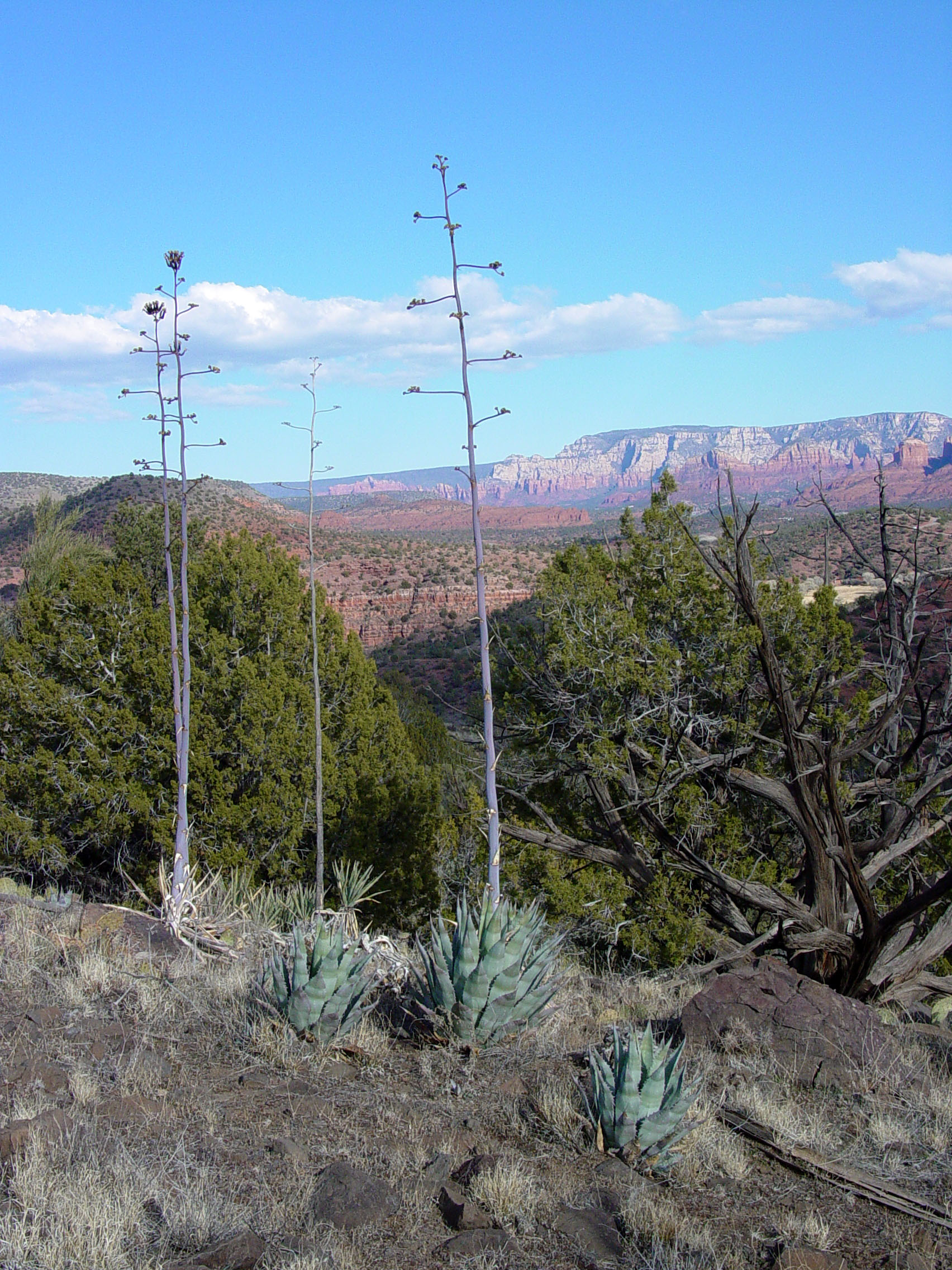
A clump of the domesticate agave species Agave delamateri in the Sedona area.
Think about the curiosity and awe that come with visiting a Native American cultural site, for example, petroglyphs and pictographs, or a historic dwelling where one can learn about and imagine what life was like for humans many hundreds of years ago. Interestingly, there is a botanical version of this in the form of culturally rich agave plants, including species found around Sedona and the Verde Valley.
Let’s begin the story with a brief primer on agave plants in general. Only after years of growing a rosette of pointy basal leaves do agaves mature, sending up a tall flowering stalk. Then the entire plant turns brown and dies. Colloquially, agaves are often called “century plants” because of the misconception that it takes up to 100 years for this life cycle to play out. In reality, each species is different in terms of how long until the flowering stalk emerges, taking anywhere from seven to over 40 years before they bloom and die. Agaves are keenly adapted to arid and semi-arid climates. For example, their leaves are succulent and able to store water, and they also have a waxy coating preventing water loss.
The main wild agave species in the Sedona area is Parry’s agave (Agave parryi). It has rigid grayish-green leaves with very sharp tips. Earlier this summer, you may have seen stalked plants with orange-red buds and bright yellow flowers, like candelabras burning steady flames above the landscape. Agave parryi is one of 16 wild agave species found in Arizona, more than any other U.S. state
Over time, humans have developed a close relationship with agaves. In Mexico, Central America, and the arid Southwest, they have been culturally important to Native peoples for thousands of years. Agaves have served as a vital, dependable food source, with their nutrition-rich hearts, and edible stalks, flowers, and sap (as pulque or syrup). The leaves provide fiber used to make clothes, sandals, cordage, and more. And the roots contain saponins, which create a soapy lather that Native peoples have used to clean hair and bodies. These numerous attributes motivated the ancestors of today’s Native tribes to domesticate and actively cultivate agaves.
Here is where the next part of the story picks up. In various parts of Arizona, including the Sedona area, plant researchers have made fascinating discoveries about agaves that were domesticated by Native peoples before the arrival of non-Indigenous explorers and colonizers, identifying them as distinct species. And more is being learned all the time. These agave “domesticates,” or PCADs (pre-contact agave domesticates), mainly reproduce via “pups,” which vegetatively offshoot from the stems below and above ground near the main plant. Because the pups are clones of the original plant from centuries ago, they have changed little if at all genetically, making them an invaluable cultural source that holds and allows us to unpack the story of their origins.
Favorable traits that were selected for during cultivation activities included flexible, easily cut leaves (making them easier to harvest for food and fiber), sweetness, drought resistance, vegetative reproduction, and shorter maturation time. Six domesticate species have been identified in Arizona, four of which can be found in the greater Sedona area: Agave verdensis, Agave yavapaiensis, Agave delamateri, and Agave phillipsiana. Unlike the wild Agave parryi, populations of the domesticate species are far less common and in decline.
In support of the U.S. Forest Service’s Red Rock Ranger District, one of the volunteer activities undertaken by the Friends of the Forest is to look for and document domesticate agave populations. This inventory then assists with ongoing research, monitoring, and conservation. Threats to the pre-historic agave populations include climate change; loss of habitat (invasive plants, development); impacts from animals including cattle, packrats, and insects; illegal poaching; and lack of human care. People are also causing direct damage through activities such as motorized vehicle use in non-motorized areas, development of trails where there shouldn’t be any, illegal collection of seeds and pups, and disturbing agave sites through establishment of New Age medicine wheels and other features.
Unfortunately, human-influenced cultivars (even those from pre-Columbian times) do not qualify for listing under the Endangered Species Act. It’s up to all of us to ensure their survival in the future. One important step is to increase awareness of the existence and unique nature of these agaves, thus helping the public gain appreciation for them and their protection. In addition, it is imperative that decisions affecting them involve collaboration not only with researchers and federal/state agencies, but especially with tribal communities such as the Yavapai-Apache Nation, whose ancestors created these culturally important plants.
To find out more about Friends of the Forest and how to become a volunteer, please visit friendsoftheforestsedona.org.

Author: Kristine Crandall
Serving Sedona, written this week by Kristine Crandall, volunteer with Friends of the Forest, appears Wednesday in the Sedona Red Rock News.